


Storax, Limited
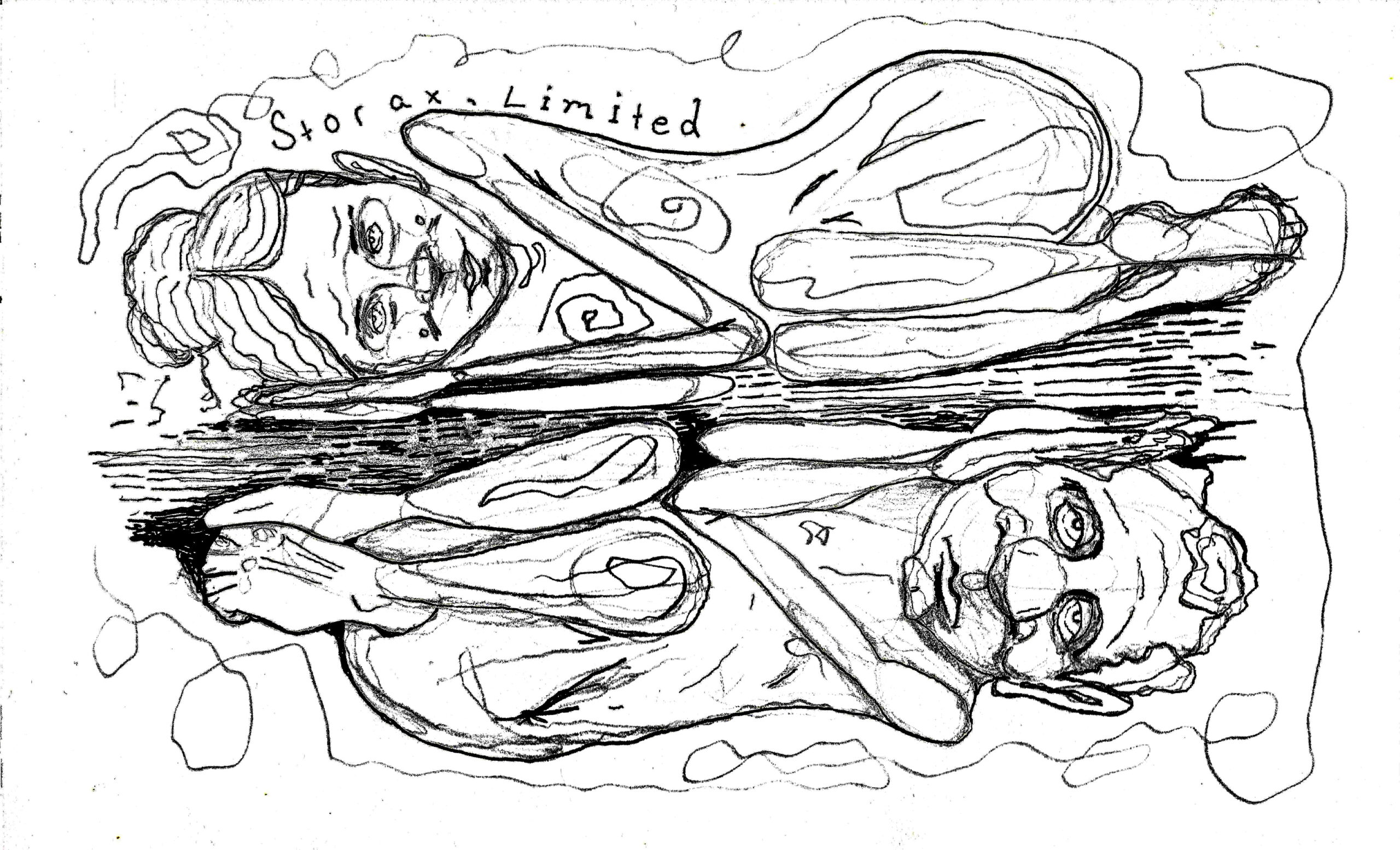
art by Robert Gemaehlich
She lives in an air-conditioned unit in Chinatown with Casper, who made a living on Botox injections until he quit because of a lawsuit. He does not speak to her about it. He does not speak to her about much at all on any given day. He comes home droopy-eyed and lays his head on the pillow and sinks into the fabric-softened sheets.
She grabs her shopping cart, which begins its journey as it will end, empty and set about with holes. She starts down the canned fruit and juice aisle, the aisle of dressings and vinegar bottles. The aisle is colorful, like a real rainbow, and she can touch it, take a can of it home with her, open it and dispose of it. The old woman in plastic curlers is filling her buggy too, plucking from the shelved, instant rainbow.
Casper now works for Polystride ThermoPlastics, a subsidiary of Petrol Carbide Limited, which is a subsidiary of Storax, which might or might not be a subsidiary of some other entity or conglomerate. At the plant he fills spreadsheets and checks chemical levels in a swivel chair at his computer, and down on the factory floor out comes polystyrene packaging foam. He comes home and lays his head on his pillow beside her in her green robe, their bodies imprinted perfectly into the mattress foam, which is provided by Polystride ThermoPlastics, a subsidiary of Petrol Carbide Limited, which is a subsidiary of Storax. On this mattress Casper falls face down next to her. They do not speak, not even about gravity. In bed they biodegrade together in silence. On some days rain taps on the window. She thinks of opening the window and blowing away.
She rolls her cart through the bread aisle, the aisle of grains and noodles and flour. The loaves are all perfectly shaped and perfectly sliced, moist, spongy, and preserved, yielding to the squeeze of a finger. On the aisle the fruitful earth is replicated in soft, tan tones. A bald man in a jersey places wheat chips in his cart up ahead. He has an uncovered scar on his leg. She looks away.
She cannot tell the difference between Casper and the form she desires as she gazes out the window in her robe. When she lets him on top of her, he feels like love, and when he puts his mouth to hers, he tastes like love. He is as good as the real thing for now, all she can afford. They are both as good as the other can afford. But if she were to leave him, she would crumple and melt in the street. So she puts her head to the pillow, tiresome, and he will come home to do the same.
She passes through the air fresheners, fabric softeners, detergents and towels. All is so white and so clean and soft and safe. She stocks her cart full and thinks of what it would be like to send the paper towels, tissues, and toilet paper flying off the shelves. They would think she was casing the store. The woman with the twins would scream. The old man in the fishing vest would grab her by the arm. The child in the rubber mask would laugh and follow her move. The rainbow of aisles would cascade into the aisles and litter all.
She lies beside Casper some mornings and thinks to stroke his hair. He puts gel in it, and she would get it on her fingers. She knows his back is turned to her because he is telling her to picture him as the man she wants him to be. Every day she is thinking of the form of the woman he wants her to be and how to shape herself to it, just like the form of the plastic Ficus in the corner that she waters every day and drains once a month.
She emerges from the frozen aisle, the aisle of glass doors and frosted meals ready to be thawed and pried from their perfect rectangular spaces. The girl at the counter chews her gum in cadence with her scanning. Chak-beep. Chak-beep. She watches the girl chew and scan, chew and scan. Chak-beep. Chak-beep. She doesn’t remember paying, but when her items are bagged, she thinks of crawling into her cart and pushing herself out the door and into the sunlight.
She makes a different stop today on her way back to Chinatown. She stops by a gift shop, distracted by the Buddha fountain with the crystal ball. She steps into the warmness of red lanterns and bamboo wind chimes. The beaming woman at the counter speaks to her.
“Hello. You looking for something for someone?”
She tells the woman, “No, just looking at things, I guess.”
She fiddles with the fans and statues, the jars and pewter dragons, the chess set with the golden feudal warriors.
“You get two of these, five dollars,” says the woman, gesturing to the sherbet-colored pinewood parasols.
“They’re very cute,” she says to the woman.
She comes to a bamboo plant in a demure glass vase. The pipe-like stalks rise and spiral upward, top leaves yearning toward the heavens.
“Oh yes, Lucky Bamboo.”
“Lucky?”
“Yes, lucky. You give it water, no sun. It brings you luck.”
The healthy green shoots arise in unison out from the well of water and pebbles.
“Is it authentic?”
“Authentic?”
“Is it real?”
The woman laughs at her shamelessly.
“Of course, is real. You take home. Come on. You bring fortune to you and your man.”
She is watering the plant when Casper gets home, kisses her routinely on the shoulder, and lays himself on the bed. He does not notice the Ficus being gone, the Ficus that was never there, just as he did not notice it on the asphalt, its performance of plastic leaves limp and glistening, its polystyrene soil chips spilling out from the busted plastic pot, labeled STORAX.
She waters the bamboo and disrobes. She must picture the form of herself as the woman she wants to be. It could have been her lying outside, and he would not have noticed her—limp and glistening. When he wakes, he will notice the bamboo, and he will pause for a moment over the fresh green stalks twirling in a kiss to the heavens, so slender, so disposable.
