


Christmas Day
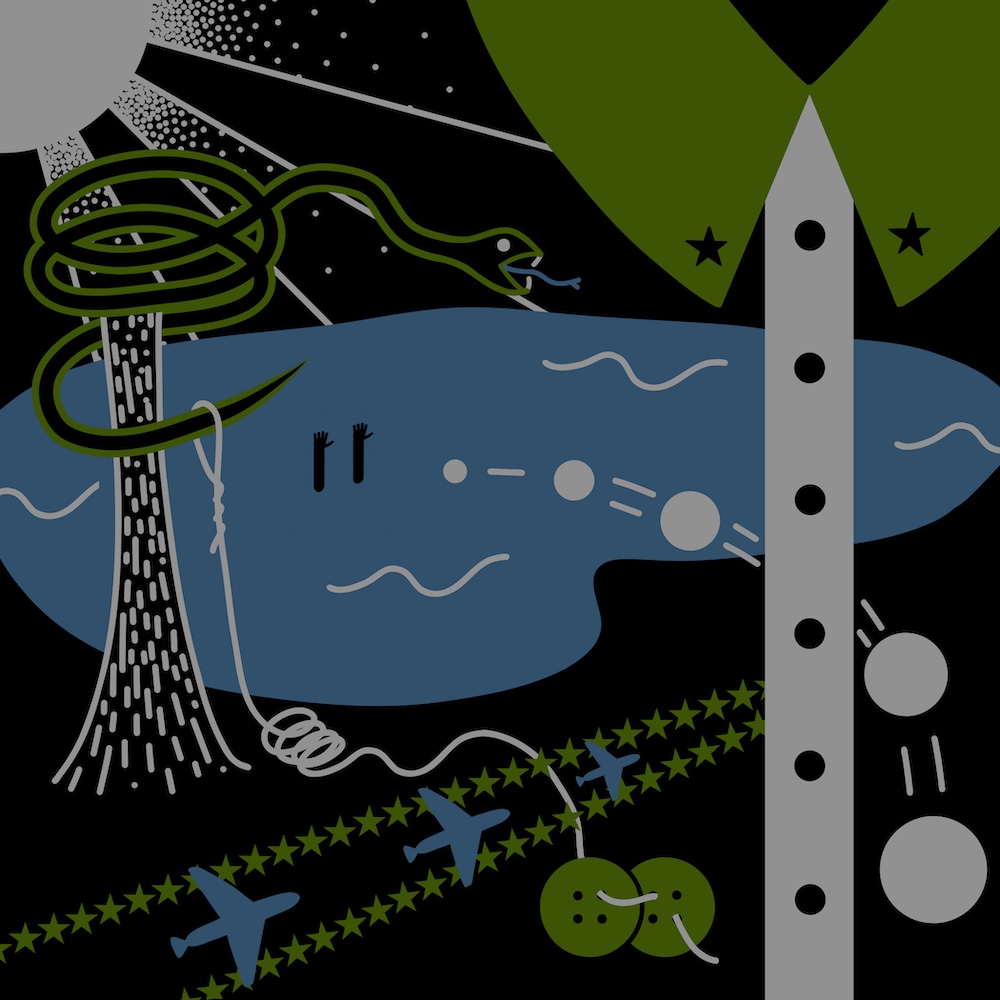
art by Meredith Dobbs
What I’m ‘bout to say don’t matter now. That’s why I’m finally saying it. Papa’s gone. Them two white men been gone. And I’m near ‘bout gone. So I’m not worried. For a long time, I thought I was a killer. But I ain’t. Never was. I want you to know that, daughter.
My favorite outfit my papa wore was his war uniform—his black shoes all shined up, stiff crease in his pants, tall collar standing up ‘round his neck. He made us all so proud, me especially. Him and my Uncle Les too. You know I’m named after him—Lester Dean. You remember me talking about him. He went off to the Negro Leagues. They were quite a pair. Went off to the war together, came back together—alive. So many didn’t. We were all so happy to see them, dressed in their full uniforms. Uncle Les never wore his again, as I recall, but Papa did once more.
It was Christmas day, 1918. I had turned 14 on the day the war ended. Papa and Uncle Les had been back about a month, and we were all gathered at Daddy’s house—your great granddaddy—for supper. The weather was good that year, almost warm. The Christmas before was bitter cold. Forrest Town even got snow. But with the better weather and with Papa and Uncle Les home, everybody was in high spirits.
We’d finished eating and everybody was laughing and telling stories. I was helping Mama wash the dishes and when I looked over, Papa was gone. I asked Uncle Les and he said he’d walked over to Rogers’s family’s place to visit with them a while. You don’t know Rogers—he never came back from the War. But you know his nieces, Elizabeth, Anna, and Jane. Anyway, I asked, and Mama said I could go over too. Elizabeth, Anna, and Jane were my friends from church and school.
I was about halfway there, coming up on the lake when I heard a white man saying my Papa’s name.
“Oscar?” I looked over in time to see that man spit, first on the ground, then on my Papa. “Boy, I thought you knew better than to wear that. Don’t look right on you.”
There were two of them and they had their hands on my Papa, one holding his arms while the other hit him, over and over. I recognized one—he worked at the mill. I didn’t know the other one.
Papa was struggling against them. “Don’t do this! Stop! It’s Christmas!”
One grabbed his collar and yanked, ripping his uniform shirt.
The other one said, “You ain’t in the army no more, boy. We got to take that off of you, ‘fore you start to getting ideas.”
That one had a rope. I could see Papa’s face now. He was scared. I was too.
The white man with rope, the one I didn’t know, took it and tried to throw it over a nearby tree branch. He missed.
I eased behind a tree. I wanted to yell but realized that would only make things worse. It was too far for me to run for help, and I couldn’t fight them myself. I looked away to keep from screaming at them and then looked at the ground.
That gave me an idea. There was a rock at my feet, ‘bout the size of a baseball. Biggest rock around. You remember that I played ball when I was young. I was the pitcher for our team. So I picked up that rock and took my best shot. Knocked that one with the rope clear in the water.
He started to yelling ‘bout how he couldn’t swim, so the other one let go of my Papa and jumped in the water to help him.
I saw the snake before he did, flashing that big white mouth. It bit him and between the snakebite and his friend grabbing on him and trying to save himself, they both succumbed to the water.
Meanwhile, Papa was gone. I tarried just a little to make sure them white men were dead and weren’t going to follow Papa or look for who threw that rock. The water was still and calm and they were in it. Somebody would find them directly, but not while me and Papa were around.
I figured I should head to Rogers’ family’s house since that’s where Mama expected me to be. By the time I got there, Papa was already there, talking with the family, but he wasn’t in the same happy mood as when he left Daddy’s house. It was clear he hadn’t told them what had happened.
We had a nice visit with them. We all hoped Rogers would be home soon. Papa and I walked back together. I didn’t say nothing, and he didn’t either. Instead, he told me what it was like to fly in a plane.
“They packed us all in pretty tight. I could see your Uncle Lester sitting catercorner across from me. There weren’t any windows for us to see out, but you could feel that thing picking up speed once it got to going.”
“Were you scared, Papa?”
“Probably would have been more scared if I had been looking out a window. When it tipped up and we all leaned back toward the back of the plane I figured we were coming up off the ground. Hours later, after we crossed that water—bump, bump—we were back on the ground, but in Europe.”
“What was it like over there?”
“The people who lived there were real nice. Much nicer than white folks here.”
Papa was quiet a while, then he reminded me of something funny Rogers’ sister had said and we both laughed again. A real laugh.
He never did talk to me about the fighting they did in the war. Years later, he’d wish me a happy birthday, and I’d wish him a happy Veteran’s Day, and he’d salute and give me his serial number. I wish I could remember his number.
A few days after Christmas, I was taking some trash out to burn and found two buttons from Papa’s uniform near the burn pile. Papa didn’t usually burn the trash (Mama liked to tend to it), but he did it a few nights ago. When I saw those buttons, I understood why.
Papa died the 24th day of August 1968. I was always glad that you got to know him. I hate you didn’t know Mama.
I never heard Papa mention a word about what happened near the lake on Christmas Day 1918. And I ain’t said nothing neither. I’m just telling you now before I close my eyes for the last time. I’m not the one made it warm enough for moccasins to be out in December. And I didn’t know that man couldn’t swim. What I did know was that my Papa was in a fix, and I was the only one who could help. His life was in my hands. Their blood is not. My heart and mind are clear. I am ready to meet the Lord. And see my Papa.
