

Alice
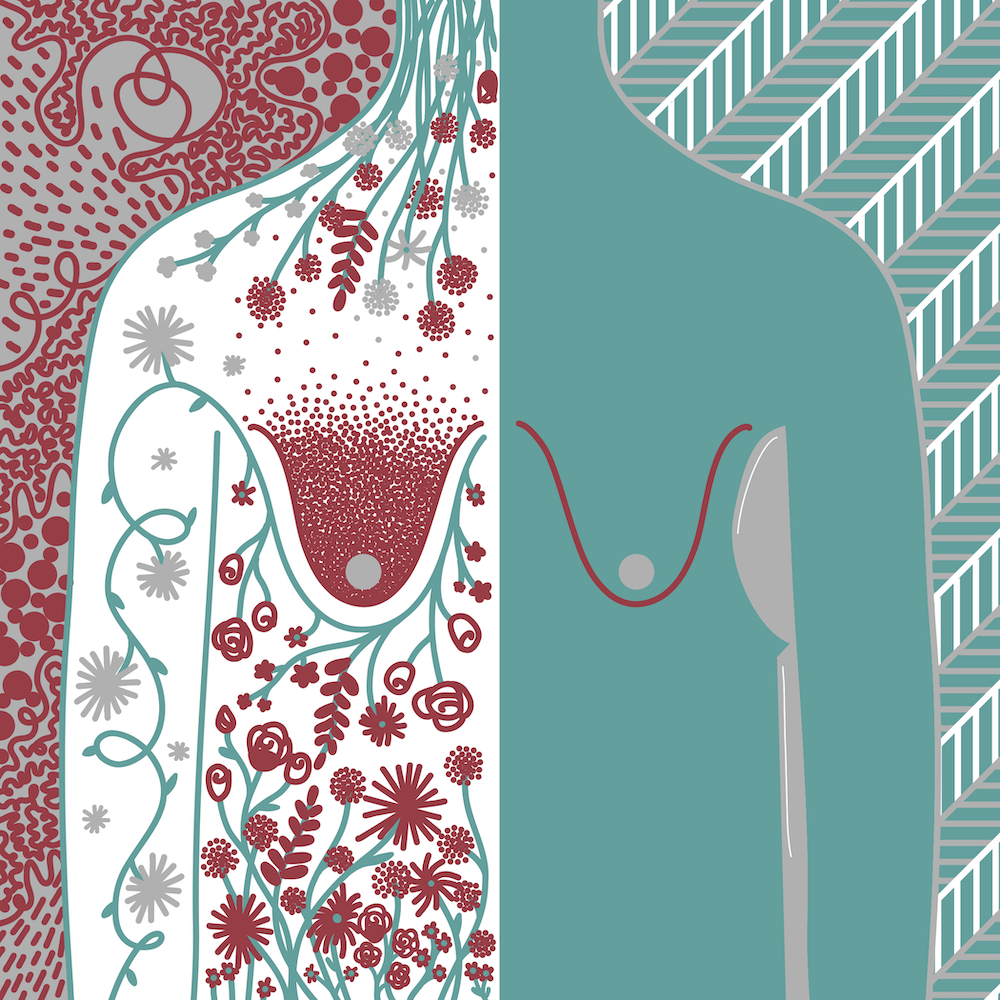
art by Meredith Dobbs
I don’t know why I suddenly remembered Alice.
Alice was my group’s cadaver in gross anatomy dissection class. She was already shrunken and stiffened by years of long exposure to formalin. She had died of breast cancer obviously. Her right breast was eaten through by the disease, and what was left was a dark rot. Her skin had become leather-tough too.
I still haven’t made peace with having to dissect Alice.
We named her Alice to make it easier, to soften the horror of handling a dead body for the first time, especially one that no longer looked fully human. Giving her a name felt like granting her dignity, even if it was one we invented. But even with a name, Alice remained faceless.
Throughout all those dissection classes, Alice was the only cadaver without a tag round her wrist. The other cadavers carried scraps of identity. Some bore names, some the dates of their deaths, something to remind us they once belonged to the world of the living. One woman didn’t have a tag either, but she wore a chain around her neck. Someone said it was real gold. At least that was something, some trace of who she had been, a proof she had been adorned.
But Alice had nothing.
Nothing except her ruined breast.
And that breast, we all avoided it like the plague. As though disease might still leap across time and formalin to infect us. We picked our cuts carefully, staying away from that right side, afraid that gloves and face masks might not be enough. And I keep asking myself: Did she live with it for long? Did she try to nurse it, hide it, bear the pain until it consumed her? Did anyone see her suffering? Or did she die alone, with no one to claim her body? Was she left long enough until her body ended up being cut open by strangers? Did she mind that the one part of her that spoke loudest of her story was the one we all refused to meet??
Around the table she lay, we all reacted differently. Some of us were intrigued, eager to see in flesh what the textbook described. Some were irritated. Some made jokes to cut through the unease. Some leaned into the thrill, scalpel in hand, eager to open what formalin had preserved, others compared what lay before us to the diagrams in Keith Moore, measuring a once-living body against the certainties of a textbook, eager to find the right words — this is the brachial plexus, this is where it begins, this is where it ends. But nerves don’t unravel neatly in a body that once lived, that once carried laughter and anger and secrets and love. On Alice’s table, the diagrams stuttered.
There are those who wouldn’t even touch anything at all, it doesn’t matter that they were armed with double gloves and lab coats. They simply stood back, convinced nothing was enough to keep Alice from reaching them still. But even those who kept their distance weren’t absent. They rolled up the sleeves of those who cut. They adjusted face masks. They pushed glasses back up the bridge of someone’s nose.
Alice was at our mercy really. And we were faceless strangers. But all of us, in one way or another, rehearsed our futures on the altar of her anonymity.
We were told to treat her body with utmost respect, that she had made a huge sacrifice and that she was the one teaching us. The word —sacrifice — followed me like a shadow. It carried a dignity I could never fully give her, because I knew nothing about Alice felt voluntary.
Sacrifice means choice, an offering laid down. But Alice’s body lay on that metal table because no one came to claim her. It wasn’t sacrifice. It was what remained after absence.
Or could Alice really let us? Could her silence equal consent?
Did Alice mind? Did she notice the way her body became both spectacle and burden, the center of our choreography of hesitation and courage?
Did she mind that a senior asked us questions from her body, and we couldn’t answer, despite her sacrifice? Did she mind that we still couldn’t name her properly; neither in anatomy, nor in life? I don’t know. I may never know.
I thought I wouldn’t be able to eat after touching her. But I ate. And that unsettled me too. How quickly the dignity we “offered” her disappeared, how easily her body became parts.
In the end, Alice became a mirror of mortality and dignity that could be named but never restored. We argued and corrected one another over her body, each person eager to prove a point until it was clear who knew best. But all our voices only buried hers deeper.
And I guess that’s the point. That in our noise, she became a mirror of what it means to be unheard.
